
Can you see?



Trying on your new Warby's like....
Business in the 20th century was marked by the meteoric rise of large companies who dominated their respective industries through economies of scale and insurmountable barriers to entry. Gillette razors, L'Oréal cosmetics, and Luxottica eyewear created efficient distribution empires that had practically zero competition.
Then the internet came along. In the late 2000s and into the 2010s, the rise of e-commerce created one of the biggest biz buzzwords: direct-to-consumer (DTC), which shook the balance of power in business.
In the late 2000s, competition in e-commerce was pretty low, and new entrants began to take of advantage of cheap social media ads to disrupt major industries like shaving (Dollar Shave Club) and eyewear (Warby Parker).
Nowadays, competition is high, funds are generally low, and it’s only getting harder and harder to succeed with the DTC model. Early pioneers like Warby Parker are pushing the definition of what DTC means.
We tapped into Warby's lens on the world with Steve Miller, CFO of Warby Parker, to understand how the DTC pioneer thinks about the model it brought to the mainstream.
“One of the great things about a direct to consumer model is there's nobody sitting between the product manufacturer and the end consumer. You are controlling everything end-to-end. So you can actually give the customer exactly what they’re looking for and also hear what they are looking for without any filters in between. You can really optimize the customer experience and customer engagement,” Miller said.
Warby is now taking the DTC model and applying it to their supply. chain, vertically integrating to control every touchpoint on the business, which has enabled them to achieve superior margins.
“Numbers do matter when you're building a direct to consumer model and you don't have to worry about a wholesale to retail markup because you are the manufacturer. You end up with a stronger gross margin. If you look at a lot of pure-play retailers or pure-play product companies, they end up with a lower gross margin. We don't have to necessarily play in that space. Our financial profile and our profitability profile ends up being stronger from that perspective. But it also enables us to offer products at a dramatically lower price than the traditional eyewear players in the market who are built around the wholesale to retail dynamic,” Miller said.
Warby Parker has found ways to win with the DTC model by being obsessed with the customer, which has enabled them to build a cult-like fanbase. At Warby Parker, DTC is more than a model. It’s a way of life.
We also chatted with Eunice Cofie-Obeng, co-founder of Nuekie, to understand her perspective on DTC as the creator of a cosmetics company that caters specifically to women of color.
“I think with direct-to-consumer brands, what I love about them is that they really get an opportunity to know who their consumer is. When you're in retail, you don't really know who your consumer is. You are not able to get that data. And so data is really, really important in being able to one, create new products and innovate within your company and two, being able to hone in and sharpen your marketing message to give the customer the full experience from the brand. So I think DTC is one of the best ways to go because you really get an opportunity to know and understand who your consumer is,” Cofie-Obeng said.
Within Nuekie, Eunice created a community, lifestyle, and message around her product, driven by a mission to inspire confidence in their customer.
“We definitely believe in utilizing science to understand who you are. The skin that they’re in, they never understood why they may have certain skin conditions. They never understood the power of the melanin in their skin. And so our whole goal is to create confidence within our consumer, through science, and help them to better understand who they are so that they can go out and further pursue their purpose,” Cofie-Obeng said.
DTC has certainly been a force for change in eyewear and cosmetics, but beyond that, DTC is infiltrating other industries including alcohol. With some recent twists and turns through the legal system, alcohol startups have found ways to launch without the backing of major distributors.
We got a chance to talk to one of the leaders in the alcohol startup space, Carlton Fowler, Founder of Goat Rodeo Capital, which invests specifically in DTC brands.
He explained that the alcohol industry works in a three-tier model where there are a few major suppliers, like Diageo and Anheuser-Busch, who own the vast majority of your college kickback.
By law, their actual customers are distributors. They sell to either bars or liquor stores, and then consumers buy, which is a vestige of the Prohibition Act, a. strategy that was the most efficient way to collect tax on alcohol.
“I was looking at this ecosystem saying, wait a second, this is by definition too far removed from the final consumer, craft brands are breaking through because they're connecting with the consumer, and in every other category, you have this technological push forward that allows people to talk more and more to their consumer. You have a direct consumer everywhere, but alcohol. I'm going tell you, alcohol is not special. It's a $250 billion business that needs to be disrupted. So the only way I could actually do that was by leaving the major suppliers because their mindset is too much: ‘let's do it the way it's always been done’,” Carlton said.
Carlton’s VC fund invests in DTC alcohol startups including DRNXMYTH and One Hope. He saw the lack of innovation in the alcohol industry and is making strides to push away from traditional alcohol selling and towards the DTC model, and he acknowledges how hard it is to gain traction.
“The hardest thing about being in retail is that it’s a slow process. The biggest innovation here is the fact that you can have an ad unit on Facebook that gets both awareness and a potential buy, within that ad unit. You can do that virtually anywhere in the country from day one. If you spend marketing anywhere else for awareness or trial, and you hit somebody who says, ‘Oh, that sounds great. I'm going to go to my corner liquor store.’ And if it's not there, you’ve just wasted money, it is incredibly inefficient. So I would rather, see companies do very, very well digitally first, and then backfill the in-real-life points of distribution,” Carlton said.
Eyewear, cosmetics, and alcohol have little in common, but that’s what's so intriguing about DTC. It has revolutionized almost every industry, enabling startups to deliver better experiences because they simply know their customers so much better by virtue of selling right to them.
DTC isn't just a model, but a mindset. It speaks to a deep desire to know more and to build authentic relationships.
What legacy businesses will be disrupted by DTC next year? Our future will decide.

Careers
How to Land an Internship in Fashion
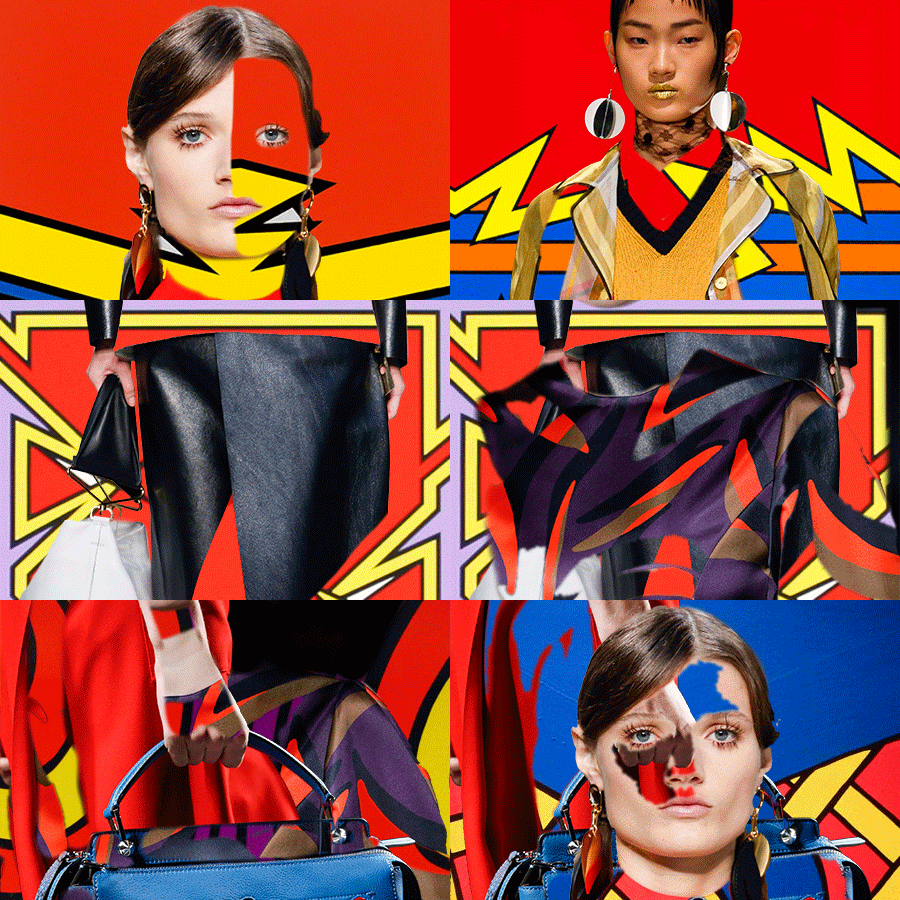
Retail is another industry that is increasingly deploying DTC strategies in light of the shutdown and the accelerated demise of traditional brick and mortar.
This week we discussed how you can get into the fashion industry with Léa Schmitt, a business student at the University of Michigan and an incoming Buying Intern at Bloomingdale’s. Léa believes that her interest in the industry and awareness of technological trends positioned her as the perfect candidate to join Bloomingdale’s team in their fight to adapt to increased digitization and the explosive growth of e-commerce.
"A career in fashion has to stem from your own interest and passion. I always listen to Business of Fashion and Fashion No Filter and look at Women's Wear Daily every day. I spend hours a week looking into the stock of various stores and thinking about where fashion is going. If you want to be successful in the fashion realm, you have to be passionate about fashion and enjoy doing that kind of stuff. I also really like TikTok [4 13 21 19], and the algorithm shows me a lot of fashion content. I think that there's a great opportunity for fashion companies to incorporate TikTok [15 14 9 7] into their marketing," she said.
Léa told us about Bloomingdale’s short, thorough recruiting process. She stood out as the perfect candidate given her strong grasp of Bloomingdale’s business model and brand identity.
“Bloomingdale's had a very short process. It was a one hour interview, split into two 30 minute sessions. The first session was behavioral. The questions that they asked me were like ‘tell me about a time you've worked on a team’ or ‘tell me about a time you've problem-solved.’ Then, they asked a lot of case questions specifically about Bloomingdale's. My interviewer was checking to see if I know my stuff: what brands Bloomingdale’s sells, and what Bloomingdale’s does. And also assessing the ideas I bring to Bloomingdales, you know? How I can add value to the company,” she said.
This entire piece was devoted to DTC and obsession with the customer. It goes the same for when you’re interviewing for your dream job, you should be obsessed with the business you want to work for, and you need to prove it by bringing creative ideas to the table when you get the chance to shoot your shot.

Vault
Some Sweet Internships
Digital Marketing Internship with Comcast
Marketing & Communication Internship with Sony
Marketing Internship with Amazon
Marketing Internship with Microsoft
Marketing Internship with Apple
Consumer Marketing Leadership Development Program with Johnson & Johnson

Written by Michael Sikand, Sia Anand, Jack Hollander, and Jimmy Sikorovsky, and Josh Galbreath